The quick answer
Appliance running costs come from three inputs: how much power an appliance draws while working, how long it actually works, and what you pay per kilowatt-hour. This guide shows how to find each number, calculate cost with visible arithmetic, compare appliances on equal terms, and recognize where estimates stop being reliable.

A space heater and a refrigerator can both show up on the same electricity bill, but they get there in completely different ways. One draws a large amount of power for a few hours; the other draws modest power almost continuously, all year. Understanding appliance running costs means understanding that difference — and being able to put a number on it before you buy something, replace something, or change how you use what you already own.
This guide covers the units behind an electricity bill, where to find the figures you need, how to calculate running costs step by step, how to compare two appliances on equal terms, and where estimates stop being trustworthy. The arithmetic works anywhere; only the price per kilowatt-hour changes with your location and tariff.
What Running Cost Actually Measures
An appliance’s purchase price and its running cost are separate things, and they move independently. A cheap appliance can be expensive to operate; an expensive one can be cheap to operate. The running cost is a product of three variables, and getting any one of them wrong throws off the answer.
Watts measure speed; kilowatt-hours measure quantity
Power — measured in watts (W) or kilowatts (kW), where 1 kW equals 1,000 W — is the rate at which an appliance uses energy at a given moment. Energy — measured in kilowatt-hours (kWh) — is the total amount used over a period. One kilowatt running for one hour is one kilowatt-hour.
A water analogy helps. Watts are like gallons per minute coming out of a faucet; kilowatt-hours are like the gallons that end up in the bucket. A wide-open faucet for two minutes and a half-open faucet for four minutes can deliver the same volume. Appliances behave the same way. A 1,500 W space heater running one hour consumes 1.5 kWh. A 300 W dehumidifier running five hours also consumes 1.5 kWh (0.3 kW × 5 h = 1.5 kWh). Same energy, same cost, very different machines.
The three inputs behind every estimate
National Energy Action, a U.K. fuel-poverty charity, summarizes the arithmetic plainly: what it costs to run an electrical appliance depends on the amount of power it needs (its power rating), the price charged per unit of electricity (the kWh rate), and how long the appliance is on. Everything else in this guide is a refinement of those three inputs rather than a replacement for them.
What a running-cost estimate does not include
A per-appliance estimate answers one narrow question: how much energy did this device use, and what is that energy worth? It is not a bill. The following are usually outside the calculation:
- Fixed charges. Many U.S. bills carry a monthly customer or service charge that does not change with usage. Running one fewer load of laundry does not reduce it.
- Taxes, surcharges, and riders. These are added on top of the per-kWh price and vary by state and utility.
- Tiered and time-of-use pricing. If your rate rises as you use more, or changes by hour, a single blended number will be wrong at the margin.
- Demand charges. Rare in typical single-family homes, common in some commercial and special residential tariffs, and driven by peak draw rather than total energy.
- Standby loads. Electronics, chargers, set-top boxes, and appliances with clocks draw power while nominally off. These are individually small and collectively worth checking.
- Gas or other fuels. A gas range, gas dryer, or gas water heater shifts most of its operating cost onto a different bill.
Treat an appliance estimate as a decision tool, not a forecast of your next statement.
Where to Find the Numbers
Before any arithmetic, you need three figures: a power rating, an honest estimate of operating time, and your price per kilowatt-hour. Each has a reliable source and a characteristic way of misleading people.
Nameplate and manual watts
Most appliances state their input power on a data plate or in the instruction manual, in watts or kilowatts. The government of South Australia’s consumer energy guidance notes that input power may be shown in watts and kilowatts, or in joules and megajoules, and that where the label shows a range, you should use the higher number to work out a maximum running cost.
Two cautions apply to every nameplate you read. First, a nameplate figure is usually a maximum or a rated draw, not an average. Second, some labels list several ratings — for example, a motor and a heater separately — and the relevant number depends on which mode you are costing.
Annual kWh and the yellow EnergyGuide label
In the United States, many major appliances carry a yellow EnergyGuide label that reports estimated annual energy use in kilowatt-hours, and for some categories an estimated annual operating cost based on a national assumption about electricity prices. For refrigerators, freezers, dishwashers, washing machines, and similar goods, the annual kWh figure is often more useful than the wattage, because it already reflects a standardized usage pattern and, where relevant, the manufacturer’s own duty-cycle behavior.
The trade-off is that the label describes a test procedure, not your kitchen. Door openings, room temperature, load size, water temperature, and how often you run the machine all push actual use away from the label. Use label kWh for comparing two similar products to each other, and use measurement or careful time estimates to understand your own bill.
Your price per kilowatt-hour
Your electricity bill states the energy you used in kWh and the money you were charged. Dividing the total by the kWh gives an effective average rate — useful as a rough starting point, but not the number to use when asking what one extra hour of appliance use costs. That question requires the marginal rate, which is covered later in this guide.
The Calculation, Step by Step
The core formulas are short enough to do on a phone calculator. The discipline lies in keeping periods and units consistent.
energy per day (kWh) = (watts ÷ 1,000) × hours per day × duty cyclecost per day = energy per day (kWh) × price per kWhmonthly cost = cost per day × number of days in that monthannual cost = cost per day × 365
The duty cycle is the fraction of the time the appliance is actually drawing full power while it is switched on. For a resistive element that stays energized the whole time, it is 1.0. For a refrigerator compressor, a cycling oven, or an air conditioner, it is lower.
Step 1: Write down the power rating in watts
Use the label or manual figure. If the label gives a range, take the high end so your answer is an upper bound rather than a hopeful guess. Record the source and the date you read it, because models change.
Step 2: Convert to kilowatts
Divide watts by 1,000. A 1,500 W heater is 1.5 kW. A 150 W appliance is 0.15 kW. This step exists only to match the units your bill uses; skipping it is the single most common arithmetic error in running-cost estimates, and it usually produces an answer that is wrong by a factor of a thousand.
Step 3: Estimate real operating hours, not just time switched on
A refrigerator is plugged in 24 hours a day but its compressor is not. South Australia’s guidance makes this point directly: not all appliances run at full power all the time, and appliances with high and low settings or thermostats — air conditioners and refrigerators are the standard examples — need a duty cycle rather than a simple on-time figure.
If you do not know the duty cycle, there are three practical routes: measure it (see the section on monitors below), infer it from annual kWh on the label (annual kWh ÷ 365 ÷ 24 gives average kW, which divided by rated kW gives an implied duty cycle), or estimate conservatively and state the assumption.
Step 4: Multiply by your price per kWh
Use a rate you can defend. If you are costing an incremental change in behavior, use your marginal rate. If you are sanity-checking a whole month, an effective rate derived from your bill is acceptable, provided you say so.
Step 5: Scale to the period you care about — carefully
Daily figures scale cleanly. Monthly and annual figures need care. Multiplying a 30-day month by 12 gives 360 days, not 365, which understates an annual total by roughly 1.4 percent. Multiplying a January bill by 12 overstates a year in which you do not heat in July. For annual estimates, multiply the daily figure by 365 and then adjust for seasonality in a separate step rather than baking it into the daily number.
Worked Example: A Space Heater and a Refrigerator
Two appliances, both familiar, illustrate how differently power and time combine. The inputs below are illustrative assumptions chosen for clean arithmetic, not typical usage figures, and the price of $0.17 per kWh is a hypothetical rate used throughout this article. Your own tariff will differ.
Appliance A: a 1,500 W space heater, eight hours a day
This is a resistive load with no thermostat cycling to account for, so the duty cycle is 1.0 while it is switched on.
- Power in kilowatts: 1,500 W ÷ 1,000 = 1.5 kW.
- Energy per day: 1.5 kW × 8 hours × 1.0 = 12.0 kWh per day.
- Cost per day: 12.0 kWh × $0.17/kWh = $2.04 per day.
- Cost per 30-day month: 12.0 kWh × 30 days = 360 kWh; 360 kWh × $0.17 = $61.20.
- Cost if run every day for a year: 12.0 kWh × 365 = 4,380 kWh; 4,380 × $0.17 = $744.60.
The annual figure is arithmetically correct and practically misleading. Few households run a space heater eight hours a day in July. If the heater is used at that level for four cold months, the seasonal cost is 12.0 × 120 days = 1,440 kWh, or $244.80 — a very different number from $744.60, and the one that belongs in a household budget.
Appliance B: a refrigerator with a 150 W compressor at a 35 percent duty cycle
Here the appliance is energized continuously, but the compressor cycles on and off. Using an assumed 35 percent duty cycle:
- Effective average power: 150 W × 0.35 = 52.5 W, or 0.0525 kW.
- Energy per day: 0.0525 kW × 24 hours = 1.26 kWh per day.
- Cost per day: 1.26 kWh × $0.17/kWh ≈ $0.214, or about 21 cents.
- Cost per 30-day month: 1.26 × 30 = 37.8 kWh; 37.8 × $0.17 = $6.43.
- Annual energy: 1.26 kWh × 365 = 459.9 kWh, about 460 kWh per year.
The interpretation matters more than the digits. The heater costs roughly ten times as much per month as the refrigerator, but the refrigerator runs twelve months a year while the heater may run for four. Over a full year, the seasonal heater at $244.80 still costs several times the year-round refrigerator at roughly $78, because the heater’s power draw is so much larger. Power, not patience, is what makes an appliance expensive.
A Comparison Table With Consistent Assumptions
The table below applies the same method, the same 30-day month, and the same hypothetical $0.17/kWh rate to seven common appliances. Every power figure, duty cycle, and daily hours value is an illustrative assumption. The rows are independent what-if scenarios, not a single household running all seven devices in the same month — a home would rarely operate a space heater and a window air conditioner at these levels simultaneously.
| Appliance | Assumed power (W) | Duty cycle | Hours per day | Energy per day (kWh) | Energy per 30 days (kWh) | Cost per 30 days (USD) |
|---|---|---|---|---|---|---|
| Space heater | 1,500 | 100% | 8 | 12.00 | 360.0 | $61.20 |
| Window air conditioner | 1,000 | 60% | 8 | 4.80 | 144.0 | $24.48 |
| Electric clothes dryer | 5,000 | 90% | 0.5 | 2.25 | 67.5 | $11.48 |
| Electric oven | 2,400 | 80% | 1 | 1.92 | 57.6 | $9.79 |
| Refrigerator | 150 | 35% | 24 | 1.26 | 37.8 | $6.43 |
| Dishwasher | 1,200 | 60% | 1.5 | 1.08 | 32.4 | $5.51 |
| LED television | 100 | 100% | 4 | 0.40 | 12.0 | $2.04 |
Two things stand out. First, the space heater alone accounts for just over half of the $120.93 total across all seven rows, even though it is the least complicated device in the table. Second, the ranking is not the ranking most people expect: the dryer outranks the oven despite running for only half an hour a day, because 5,000 W is a lot of power to concentrate into a short window. Neither result is a general truth about appliance types; both are consequences of the assumed inputs. Change the heater’s hours or the dryer’s weekly load count and the order changes.
Why Rated Watts Can Mislead
Nameplate wattage is where most estimates begin and where many of them quietly go wrong. A handful of physical behaviors explain the gap between the label and the meter.
Thermostats and cycling
Anything that holds a temperature — a refrigerator, freezer, oven, water heater, air conditioner, or iron — switches its heating or cooling element on and off. The element’s rated draw applies only during the on portion. This is exactly the case South Australia’s guidance flags when it warns that appliances with thermostats do not run at full power all the time. Ignoring cycling overstates energy use, sometimes by a factor of two or three.
Heat pumps and inverter compressors
Modern refrigerators and air conditioners often use variable-speed compressors that ramp up and down rather than switching between full power and nothing. Their rated draw may be a maximum that is reached only on a hot day or after a door has been open. A duty-cycle model is a crude approximation for these machines, but it is usually closer than assuming continuous full-power operation.
Load, setting, and environment
Two identical dryers in two homes use different amounts of energy. Load size, how wet the clothes are after spinning, vent condition, and room temperature all matter. The same applies to dishwashers (cycle selection and inlet water temperature), ovens (preheating, opening the door, and whether the cookware fits the cavity), and refrigerators (room temperature, door openings, and how full the shelves are).
Age, condition, and maintenance
A worn door gasket, a dust-clogged condenser coil, or a failing compressor can raise a refrigerator’s energy use well above its original rating. Estimates built from the original specification describe the appliance as built, not as it is now.
Switched on is not the same as working
A washing machine that sits filled but not running, a television on standby, and an oven with the light on are all drawing power without doing their main job. Standby draw is small per device — a few watts — but it runs 8,760 hours a year, so it belongs in a whole-home review even when it does not belong in a per-use calculation.
Measuring Instead of Guessing
Estimates are fast and free. Measurement is slower but removes the largest source of error: your guess about hours and duty cycle.
Plug-in energy monitors
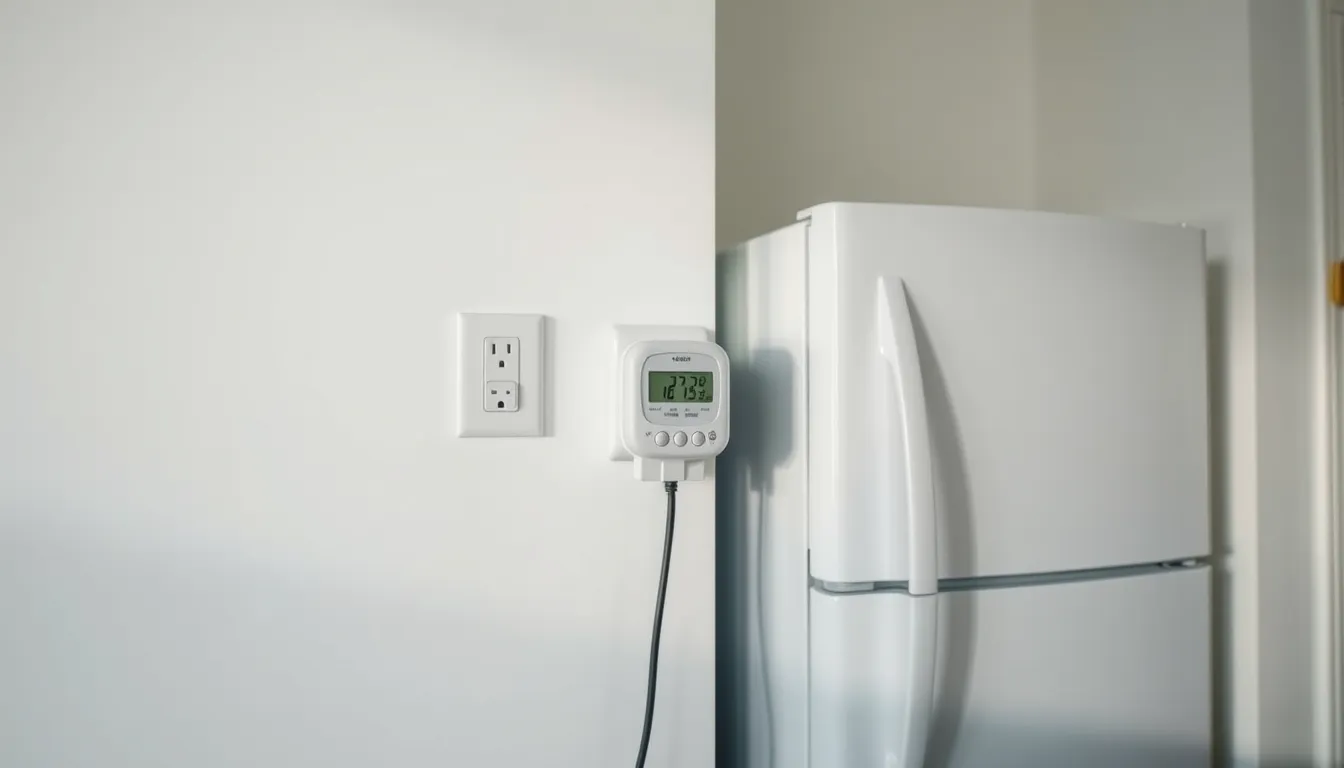
A plug-in energy monitor sits between the wall outlet and the appliance. Better models record cumulative kilowatt-hours over time as well as instantaneous watts, which means you can measure a full dishwasher cycle or a week of refrigerator operation and read the energy used directly. To use one well, measure a representative period — a normal week rather than a holiday week — and note the conditions, because a refrigerator measured in a cool room in spring will not match August.
Plug-in monitors have hard limits. Standard household units are built for 120-volt cord-and-plug loads and cannot be used on 240-volt appliances such as electric dryers, ranges, and central air conditioners, and they cannot measure anything that is hardwired. Check the monitor’s rated current against the appliance before use; a high-draw appliance such as a space heater may exceed a small monitor’s capacity.
Whole-home monitoring and smart meters
Interval data from a utility smart meter or a whole-home monitoring device can show the effect of turning an appliance on and off, which is a practical way to estimate a large hardwired load without instrumenting it directly. The technique is to record a baseline period, switch on only the appliance in question, and look at the step change in the interval data. Accuracy depends on interval length — 15-minute data is workable for a dryer, poor for a microwave.
When measurement is not practical
For hardwired appliances, the alternatives are an estimate from label data, a clamp-style meter installed by a qualified electrician, or a manufacturer’s published consumption figures. Any work inside a panel or on a 240-volt circuit is a job for a licensed electrician, not a weekend project.
A hybrid approach that usually works
Measure a short period and scale it. Run the dishwasher three times with a plug-in monitor, take the average per cycle, and multiply by your real weekly cycle count. One week of monitoring plus an honest usage count typically beats a label-based estimate by a wide margin, at a fraction of the effort of measuring everything all year.
Getting the Price Per Kilowatt-Hour Right
The third input is the one households most often get wrong, because the number printed largest on a bill is rarely the number that applies to the next hour of appliance use.
Effective rate versus marginal rate
Your effective rate is total billed amount divided by total kWh. If a bill totals $152.40 for 900 kWh, the effective rate is about 16.9 cents per kWh. That figure is useful for describing last month. It is the wrong figure for asking what an extra 100 kWh would cost if your plan’s top tier is 22 cents, because the extra usage is priced at the margin, not at the average. The difference in that example is roughly $5 on 100 kWh — small per decision, meaningful across a year of appliance choices.
Tiers and time-of-use periods
Tiered plans charge progressively more as monthly usage crosses thresholds. Time-of-use plans charge different prices by hour and season, so a dryer load at 8 p.m. and the same load at 11 a.m. can cost different amounts. Both structures mean a running-cost estimate should name the rate it used and the assumption behind it.
Fixed charges and the delivery split
Many U.S. bills separate supply from delivery, and both may include per-kWh components plus fixed amounts. A working rule: use the sum of all per-kWh components — supply, delivery, and any volumetric riders — as your variable price, and exclude the fixed customer charge. Read the bill’s own breakdown rather than estimating from memory.
Beware of tools built on another region’s tariff
Published running-cost calculators are convenient but not portable. Northern Ireland’s Consumer Council, for example, offers an appliance cost checker that estimates daily, weekly, and annual running costs and compares appliances, and it states that its calculations use the regulated Power NI unit rate of 34.150p per kWh, with appliance data supplied by the Centre for Sustainable Energy. That is a legitimate, well-documented tool for the consumers it was built for — and its default rate would be badly wrong for a household in Ohio. Use such tools to learn the method, then substitute your own rate.
Comparing Two Appliances Fairly
Most running-cost mistakes happen at the comparison stage rather than the calculation stage. A fair comparison holds service, usage, and period constant, then adds purchase price back in.
Compare like with like
Two appliances can only be compared if they deliver the same service at the same level of use over the same period. A 1,500 W countertop oven and a 3,000 W full-size oven are not interchangeable at Thanksgiving. A heat-pump dryer and a resistance dryer handle different fabrics and take different times. Define the service first, then cost it.
A cooking comparison that is often done badly
Cooking appliances are the classic case, because their wattages differ enormously and their cooking times differ in the opposite direction. Using illustrative figures:
- Microwave: 1,200 W for 10 minutes = 1.2 kW × 0.167 h ≈ 0.20 kWh, about 3 cents at $0.17/kWh.
- Air fryer: 1,500 W for 20 minutes at roughly full duty = 1.5 kW × 0.333 h ≈ 0.50 kWh, about 8.5 cents.
- Full-size electric oven: 3,000 W for one hour at an assumed 80 percent duty cycle = 3.0 kW × 1 h × 0.8 = 2.40 kWh, about 41 cents.
The oven uses roughly twelve times the energy of the microwave for that pair of tasks. That does not make the microwave a substitute for roasting a chicken. It does mean that using the smallest appliance that can do the job is one of the few energy decisions with no comfort penalty. Smart Energy GB’s kitchen guidance frames the same principle: comparing common cooking appliances on running cost is a practical way to make smarter cooking choices and cut waste, and its material compares oven, slow cooker, and air fryer use.
Purchase price plus operating cost
The honest comparison is total cost of ownership: purchase price plus the present value of operating cost over the years you expect to keep the appliance. For a rough screen, simple payback is enough: divide the extra purchase price by the annual energy savings.
A payback example that argues against upgrading
Suppose a new refrigerator uses 400 kWh per year and the old one uses 600 kWh per year, a saving of 200 kWh annually. At the hypothetical $0.17/kWh rate, that is $34 per year. If the new unit costs $900 more than a basic alternative, simple payback is $900 ÷ $34 ≈ 26 years.
The arithmetic is unglamorous but useful. Efficiency alone rarely justifies replacing a working appliance. Replacement decisions usually rest on repair costs, reliability, size or features, refrigerant and safety concerns, or a genuine failure — with energy savings as a secondary benefit. Rebates and incentives can change the math, but only if you verify the current program terms for your address and utility; they are not a general assumption.
What Usually Drives an Appliance Bill
Individual calculations tell you about individual devices. A household view needs a sense of proportion. In most U.S. homes, space heating and cooling and water heating account for the largest shares of energy use, followed by refrigeration, laundry, cooking, lighting, and electronics, with wide variation by climate, home age, and whether major systems run on gas or electricity.
Two consequences follow. First, a modest improvement in a large load usually beats a heroic improvement in a small one — insulating a water heater or sealing ductwork can outweigh months of conscientious standby-unplugging. Second, fuel type shifts cost between bills. A gas range or gas dryer may barely register on the electricity bill while still costing money on the gas bill, so an electricity-only view can make the wrong appliance look free.
Practical Next Steps, Ordered by Effort and Cost
No-cost checks you can do this week
- Find your price per kWh on a recent bill, including all volumetric components, and write it down.
- List the five appliances you suspect matter most. For most households this means heating or cooling equipment, water heating, refrigeration, laundry, and cooking.
- For each, note the wattage from the label and roughly how many hours a day or cycles a week it runs.
- Run the four-line calculation for each and rank them. The ranking, not the individual numbers, is what should guide your attention.
- Check settings that cost nothing: refrigerator and freezer temperatures, washing machine water temperature, dishwasher cycle selection, dryer moisture sensor versus timed dry, and thermostat schedules.
Low-cost steps
- Buy or borrow a plug-in energy monitor and measure your refrigerator for a week and your most-used countertop appliance over several normal uses.
- Clean refrigerator condenser coils and dryer lint filters and check door seals; degraded performance shows up as longer runtimes.
- Move small appliances to a power strip only where standby loads are genuinely worth the inconvenience — entertainment centers and computer desks, typically — rather than treating every outlet as a project.
- Air-dry dishes and use the dryer’s moisture sensor rather than a fixed timed cycle.
Upgrades that need quotes or a professional
- If you are replacing a failed appliance anyway, compare models on annual kWh from the EnergyGuide label and weigh the operating-cost difference against the price difference.
- For water heaters, HVAC equipment, and anything hardwired, get written quotes and ask explicitly for estimated annual energy use, not just a capacity rating.
- Ask your utility or state energy office about current rebates and whether an energy assessment is available; verify eligibility for your specific address before treating any incentive as certain.
- Have any panel work, 240-volt circuit modification, or hardwired monitoring installed by a licensed electrician.
Common Mistakes and the Limits of Estimates
- Forgetting to divide by 1,000. Watts are not kilowatts. This error produces answers off by three orders of magnitude and is surprisingly common in informal comparisons.
- Treating rated watts as average watts. For any cycling appliance, this overstates energy use.
- Multiplying a 30-day month by 12. That yields 360 days and understates annual use by about 1.4 percent.
- Assuming year-round operation of a seasonal appliance. Space heaters, air conditioners, and dehumidifiers are the usual offenders.
- Using an effective rate for a marginal decision. Under tiered or time-of-use pricing this systematically understates the cost of extra usage.
- Comparing appliances that do different jobs. A microwave and an oven are not competing products for most meals.
- Ignoring the fuel bill. A gas appliance’s operating cost is mostly on the gas bill.
- Expecting a calculator to know your habits. A running-cost tool is only as good as the hours and rate you feed it.
None of these limitations makes estimation pointless. A calculation with stated assumptions is far more useful than a vague impression, provided you remember that the number describes the assumptions as much as the appliance.
A Decision Checklist
- What is the decision? Replacing an appliance, changing a habit, or simply understanding a bill? Each calls for a different level of precision.
- What is the appliance’s rated power, and where did that figure come from?
- Does it cycle? If so, what duty cycle am I assuming, and on what basis?
- What period am I costing — a day, a month, a season, a year?
- Which price per kWh applies: effective or marginal, flat or tiered, anytime or time-of-use?
- Have I excluded fixed charges that will not change regardless of my decision?
- Am I comparing like service levels over identical periods?
- If this is an upgrade, what is the simple payback, and does it survive realistic assumptions about how long I will keep the appliance?
- Would measuring for a week change my answer? If yes, measure before buying.
The single most useful habit is the smallest one: before you act on an appliance, write down three numbers — watts, hours, and your price per kWh — and do the four-line calculation. That short exercise turns a vague worry about the bill into a specific, checkable claim about which appliance deserves your attention and which can safely be left alone.
FAQ
How do I calculate an appliance's running cost in one line?
Convert watts to kilowatts by dividing by 1,000, multiply by hours of actual operation (times any duty cycle), then multiply by your price per kWh. For example, 1,500 W for 2 hours at $0.17/kWh is 1.5 × 2 × 0.17 = $0.51. The result is only as good as your hours estimate.
Should I use the rate on my bill or a different number?
Use your effective rate (total bill divided by total kWh) to describe a past month. Use your marginal rate for decisions about changing usage, because under tiered or time-of-use pricing an extra kWh may cost more than your average. Exclude fixed customer charges either way.
Why does my appliance seem to use more energy than its label suggests?
Labels report standardized test conditions, and your home is not a test laboratory. Room temperature, load size, door openings, water temperature, clogged coils, worn seals, and how long you actually run the appliance all push real use above the label figure.
Can I measure a dryer, range, or central air conditioner with a plug-in monitor?
Usually not. Standard plug-in monitors are built for 120-volt cord-and-plug loads, and dryers, ranges, and central air conditioners are typically 240-volt or hardwired. Estimating from label data, reading interval data from a smart meter, or having a licensed electrician install a clamp meter are the realistic alternatives.
Is it worth replacing a working appliance to save energy?
Often not on energy savings alone. If a new refrigerator saves 200 kWh a year at $0.17/kWh, that is $34 annually; against a $900 price difference the simple payback is roughly 26 years. Replacement decisions usually rest on repair costs, reliability, and features, with efficiency as a secondary benefit.
Are online running-cost calculators reliable?
The arithmetic in them is usually sound, but the defaults often are not yours. Northern Ireland's Consumer Council tool, for example, uses a fixed regulated Power NI rate of 34.150p per kWh for its audience. Use a calculator for the method, then replace the rate and hours with your own figures.
Follow the evidence
Sources & references
- National Energy Action (NEA), 'How much do your electrical items cost to run?', last updated April 2025, https://www.nea.org.uk/get-help/leaflets/how-much-do-your-electrical-items-cost-to-run/
- Government of South Australia (SA.GOV.AU), 'Calculate appliance running costs', https://www.sa.gov.au/topics/energy-and-environment/using-saving-energy/calculate-running-costs
- Smart Energy GB, 'Energy saving in the kitchen: appliance running costs', https://www.smartenergygb.org/smart-living/smart-energy-tips/energy-saving-in-the-kitchen
- Consumer Council (Northern Ireland), 'Appliance Cost Checker Tool', https://www.consumercouncil.org.uk/consumers/help-consumers/electricity-oil-and-gas/appliance-cost-checker-tool
Useful terms in this guide
- Kilowatt-hour (kWh)
- The unit of energy your electricity bill is based on. One kWh is 1,000 watts used continuously for one hour.
- Duty cycle
- The share of time an appliance is actually drawing full power while switched on. A refrigerator compressor might run roughly a third of the time, giving a duty cycle near 0.35.
- Effective rate
- Total billed amount divided by total kWh used. Useful for describing a past bill, but not for pricing an extra hour of appliance use under tiered or time-of-use plans.
- Marginal rate
- The price of the next unit of electricity you use, which may be higher than your average because of tiers, time-of-use periods, or volumetric riders.
- Simple payback
- The extra cost of a more efficient appliance divided by its annual energy savings, expressed in years. It ignores financing, inflation, and repairs.
Have a question about these numbers?
Tell us what needs a closer look.