The quick answer
Fixed charges usually remain the same no matter how much energy you use, so turning things off mainly reduces the usage portion of the bill. You can change fixed charges only by changing the plan, supplier, or connection arrangement, while usage charges respond to consumption, timing, and rate choice.
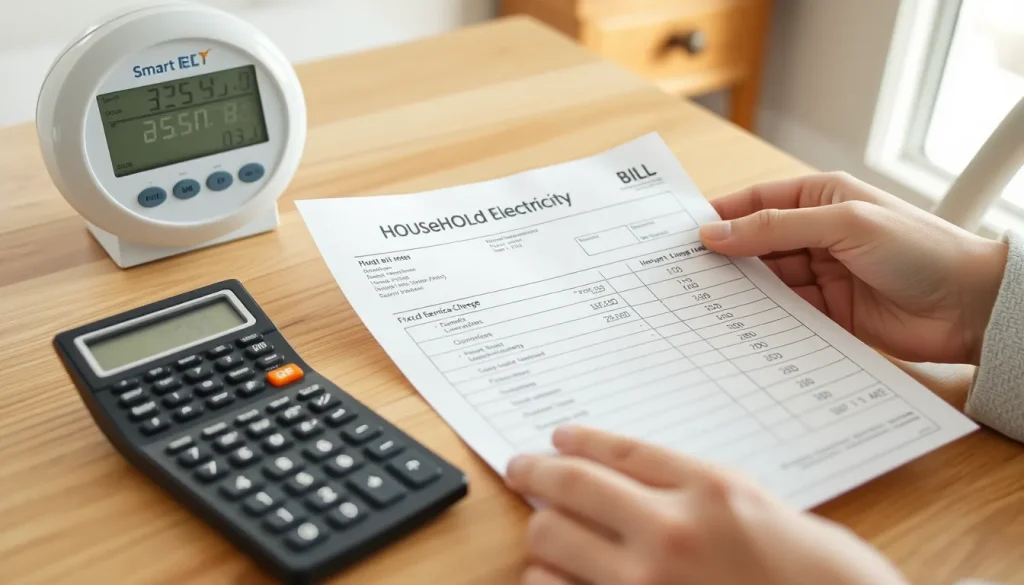
A monthly energy bill looks like one number, but it is built from parts with different rules. Some parts move when you adjust the thermostat, run the dishwasher at a different hour, or buy a more efficient appliance. Others stay the same whether you use a little energy or a lot. The practical question is not simply which charge is bigger; it is which charge your decisions can actually affect.
Consumer energy guides in several markets describe the same basic split. The Energy Ombudsman lists usage, standing charges, and VAT as common bill components. Australia’s Energy Made Easy says gas and electricity tariffs have a daily supply charge and a usage charge, while NSW Climate and Energy Action explains that the fixed charge covers transport, connection, poles and wires, administration, and meter reading. Powerswitch NZ describes a daily fixed charge as the cost of getting power to the home. U.S. bills use different labels and rules, but the same functional distinction usually appears: a service or customer charge that does not depend on consumption, and a volumetric charge that does.
The direct answer: what can and cannot be changed
Usage charges are the part most households can change directly. You change them by using fewer kilowatt-hours, shifting consumption to a cheaper time if your plan has time-of-use rates, or choosing a plan or supplier with a different usage rate. Fixed charges are different. On a given plan and connection, they generally do not fall because you turned off lights or took a shorter shower. You can change them only by changing the plan, supplier, or connection arrangement, and some fixed delivery charges remain the same no matter which retail supplier you choose.
Taxes, universal service fees, and some regulatory charges are usually outside a household’s control, apart from limited exemptions or assistance programs. A bill can also include demand charges, minimum bills, deposits, late fees, and credits. Those lines need to be identified separately before you decide what is changeable.
What fixed and usage charges do
A fixed charge is a charge per day or per month that applies even when no energy is used. It may be called a customer charge, monthly service charge, basic service fee, supply charge, or standing charge. The Energy Ombudsman notes that consumers cannot opt out of standing charges or reduce them by not using gas or electricity, and that zero standing charge deals are rare and come with catches. That warning is useful in any market: a plan with no monthly fee may recover the cost through a higher usage rate or other terms.
A usage charge is volumetric. Electricity is usually billed in cents per kilowatt-hour (kWh), while natural gas may be billed per therm or per hundred cubic feet (ccf), depending on the utility. A simple pre-tax bill estimate is:
bill before tax = fixed service charge × billing days + energy used × usage rate + other charges
For a monthly fixed charge, divide by the number of billing days to get a daily equivalent. A $12 monthly charge over a 30-day month is $0.40 per day. That daily figure matters because a 28-day bill and a 34-day bill can have different total fixed charges even if the daily rate is unchanged.
How the charges work together
Fixed and usage charges interact. A plan with a low fixed charge often has a higher usage rate. That can be a good deal for a low-use household and a poor deal for a high-use household. A plan with a higher fixed charge and a lower usage rate can work in the opposite direction. The right comparison is not the fixed charge alone or the usage rate alone; it is the total pre-tax cost at your own consumption level, over the same number of billing days.
This is also why the average price per kWh on a bill is not the same as the usage rate. The average includes fixed costs spread over the energy used. If you use less energy, the fixed charge is spread over fewer kWh, so the average price can rise even while the total bill falls.
A worked example: one bill, two levers
Assume a hypothetical 30-day month with a $12 monthly fixed charge, 750 kWh used, and a usage rate of 16 cents per kWh. Taxes and other fees are excluded.
Fixed charge: $12.00. Usage charge: 750 × $0.16 = $120.00. Pre-tax total: $12.00 + $120.00 = $132.00. The effective average rate is $132.00 ÷ 750 kWh = $0.176 per kWh, or 17.6 cents per kWh, even though the stated usage rate is 16 cents.
Now cut usage by 100 kWh to 650 kWh. Usage becomes 650 × $0.16 = $104.00. The new pre-tax total is $12.00 + $104.00 = $116.00, a saving of $16.00. The effective average rate is $116.00 ÷ 650 kWh = about $0.178 per kWh, or 17.8 cents. The bill fell, but the average cost per kWh rose because the fixed charge did not change. The $16 saving is the marginal value of that 100 kWh reduction under this simplified rate.
Scenario comparison: fixed-charge trade-offs
The table below compares two hypothetical plans at several monthly usage levels. It excludes taxes, fees, demand charges, and credits. The plans are illustrative, not quotes.
| Monthly use (kWh) | Plan A: $12 fixed, 16 cents/kWh | Plan B: $20 fixed, 13 cents/kWh | Lower pre-tax bill |
|---|---|---|---|
| 100 | $28.00 | $33.00 | Plan A by $5.00 |
| 400 | $76.00 | $72.00 | Plan B by $4.00 |
| 750 | $132.00 | $117.50 | Plan B by $14.50 |
| 1,200 | $204.00 | $176.00 | Plan B by $28.00 |
Plan B has the higher fixed charge but the lower usage rate. At 100 kWh, Plan A is cheaper because the fixed charge dominates. At 400 kWh, Plan B is already cheaper. The crossover is about 267 kWh: solve $12 + $0.16x = $20 + $0.13x, which gives x = 8 ÷ 0.03 = 266.7 kWh. Above that level, Plan B’s lower usage rate outweighs its higher fixed charge in this simple example. Actual plans can have tiered rates, time-of-use periods, minimum bills, or different contract terms that change the result.
What usually cannot be changed by turning things off
Turning off an appliance does not reduce a fixed customer charge. It also does not reduce a regulated delivery charge that is built into the rate. In some states, the delivery portion of the bill is separate from the supply portion, and shopping for a retail supplier changes only the supply side. Municipal utilities and cooperatives may have their own structures. A household should read the bill labels rather than assume that every fixed line is negotiable.
Demand charges are a separate case. They are based on peak power in kilowatts (kW), not total energy in kWh, and they appear more often on some commercial or special residential tariffs. If a demand charge applies, managing simultaneous high-power appliances at the peak interval can matter. It is not the same as using fewer kWh over the month.
Renters, homeowners, and appliance buyers
Renters usually control usage behavior and appliance use more than structural equipment. They can shift laundry and dishwashing to off-peak periods if the rate plan allows it, use cold water, seal obvious drafts where permitted, and ask the landlord about inefficient appliances. They generally cannot change the building’s service charge, wiring, or heating system without the owner’s involvement.
Homeowners have more levers: choosing a different rate plan or supplier where retail choice exists, improving insulation and air sealing, replacing an old appliance, or adding load controls. Those changes can reduce usage charges, but they involve upfront costs and should be compared over equivalent service levels. A renter-friendly action and a structural upgrade should not be treated as the same kind of decision.
Appliance buyers should focus on the kWh or therms the appliance is likely to use in actual operation, not just the nameplate wattage. A space heater rated at 1,500 watts uses 1.5 kWh for each hour at full power, but thermostat cycling and room conditions change the average. The formula kWh = watts ÷ 1,000 × operating hours gives a useful estimate when the hours are stated as an assumption. That estimate addresses the usage charge, not the fixed charge.
How to tell which part of your bill changed
Use a short checklist before changing plans or blaming an appliance:
- Compare two bills with the same number of billing days and, where possible, similar weather and occupancy.
- List the fixed charge, the kWh used, the usage rate, taxes, fees, credits, and any demand or minimum charge.
- Recompute the usage line from kWh and rate. If it does not match, look for tiers, time-of-use periods, or a rate change.
- Calculate the effective average rate as total bill divided by kWh. Use it for bill comparison, not as the price of the next kWh.
- Check the plan’s fixed and usage rates at your own annual consumption, not at a generic advertised usage level.
This process separates a change in consumption from a change in rates or fees. A higher bill with similar kWh is not explained by usage alone; check billing days, fixed charges, taxes, credits, and rate changes.
Common mistakes that obscure the fixed-versus-usage split
One common mistake is assuming a lower total bill always means a cheaper plan. A lower bill may reflect a shorter billing period, milder weather, or a one-time credit. Another is treating the effective average rate as the marginal cost of extra usage. The marginal cost is the usage rate that applies to the next kWh, which may be tiered or time-dependent.
A third mistake is assuming a zero fixed charge is free. The Energy Ombudsman’s warning about rare zero standing charge deals with catches applies broadly: check the usage rate and contract terms. A fourth mistake is expecting a 10 percent cut in kWh to produce a 10 percent cut in the bill. Only the usage portion falls; fixed charges, taxes, and fees dilute the percentage saving. A fifth mistake is shopping only the supply rate when fixed delivery charges remain with the regulated utility.
Limits and regional differences
U.S. household energy rules vary by state, utility type, and rate schedule. Some states allow retail electricity choice; others leave supply with a regulated utility. Gas bills may use therms or ccf rather than kWh. Low-income discounts, medical baselines, senior rates, and weatherization programs can change the bill in ways that are not visible in the standard fixed-versus-usage split. The sources cited here describe UK, Australian, and New Zealand consumer guidance; they are used for the common charge definitions, not as statements of U.S. law or current U.S. prices.
The most reliable next step is to take one recent bill, mark every line as fixed, usage, tax or fee, or credit, and calculate your effective rate. Then compare any alternative plan using your own last 12 months of kWh and the same billing-day assumptions. That turns a general question about fixed and usage charges into a decision you can check against your own usage.
FAQ
Can I avoid fixed charges by using less energy?
Generally no. A fixed service charge applies regardless of consumption on that plan. A rare zero-fixed-charge plan may have a higher usage rate or other conditions, so compare the total bill at your own usage.
Why did my bill rise when my kWh stayed about the same?
Check billing days, fixed charges, usage rates, taxes, fees, credits, and any plan change. A longer billing period or a higher fixed or usage rate can raise the bill even when kWh is similar.
Does a 10 percent usage cut equal a 10 percent bill cut?
No. Only the usage portion falls. Fixed charges, taxes, and fees dilute the percentage saving, so the bill reduction is usually smaller than the reduction in kWh.
Are fixed charges the same as delivery charges?
Not always. A delivery charge can include both fixed and volumetric components, and the labels vary by utility and state. Read the line items rather than assuming every delivery line is fixed.
Follow the evidence
Sources & references
- Energy Ombudsman. How to Understand Your Electricity and Gas Bills. Published April 24, 2025. https://www.energyombudsman.org/advice-for-consumers/how-to-understand-your-electricity-and-gas-bills
- NSW Climate and Energy Action. Energy charges and fees. https://www.energy.nsw.gov.au/households/bills/charges-fees
- Energy Made Easy. Understanding gas and electricity charges. https://www.energymadeeasy.gov.au/article/understanding-gas-and-electricity-charges?id=whats-on-your-energy-bill
- Powerswitch NZ. How to read your power bill. https://www.powerswitch.org.nz/finding-the-best-power-plan/how-to-read-your-power-bill
Useful terms in this guide
- Volumetric charge
- A charge that rises with each unit of energy used, such as cents per kWh.
- Customer charge
- A fixed monthly fee on many U.S. electricity bills that covers billing and service costs.
- Effective rate
- Total bill divided by kWh used; it includes fixed costs and is not the same as the marginal usage rate.
- Demand charge
- A charge based on peak power in kW, not total energy in kWh; more common on some commercial and special tariffs.
Have a question about these numbers?
Tell us what needs a closer look.