The quick answer
Renters can lower energy waste without renovations by sealing drafts with removable weatherstripping, draft stoppers, and window film; switching to LED bulbs; cutting standby loads; and using appliances and heating or cooling controls more deliberately. Larger items such as insulation or heating-system controls generally require landlord involvement. Savings vary with climate, utility rates, lease terms, and how the home is used.
Renters often control the bulbs, blinds, plugs, and habits in a home but not the insulation, furnace, or windows. That still leaves many useful actions. The practical approach is to start with changes that are removable, portable, or easily reversed, then ask the landlord about work that affects the building or its equipment. This guide focuses on those renter-controlled steps and on how to estimate whether they are worth doing.
Start with a renter-friendly energy walk-through
Before buying anything, gather three kinds of information: what your lease allows, what your utility bill actually shows, and where your home wastes energy. Read the lease for rules on window coverings, adhesive products, thermostat changes, and alterations. Then compare at least two utility bills with similar billing days and seasons so weather and occupancy do not distort the comparison. Note fixed charges separately from usage charges, because a lower kWh total does not always translate one-for-one into a lower bill.
Walk through each room and list: drafty windows and exterior doors; incandescent or non-LED bulbs; electronics and chargers that stay lit; appliances that run with partial loads; and rooms that feel too hot or cold. This list becomes your action plan and, if needed, the basis for a written request to the landlord.
Seal drafts with lease-safe materials
Air leaks around windows, doors, and vents make heating and cooling work harder. The renter-safe version is to use removable products rather than permanent caulk or construction adhesive. Energy Trust of Oregon recommends peel-and-stick or tension-mounted weatherstripping for doors and windows, door draft stoppers, removable window insulation film applied with double-sided tape, and rugs over bare floors. These options are designed to be removable and can be taken with you when you move [3]. The U.S. Department of Energy also lists sealing air leaks and using weatherstripping or caulking as basic efficiency steps, but in a rental the removable route is usually the better fit [2].
Weatherstripping is a flexible strip or seal that closes the gap where a window or door meets its frame. A draft stopper—sometimes called a draft snake—sits at the bottom of an exterior door. Removable window film creates a temporary sealed layer over a leaky window. None of these changes replaces a broken window, a missing storm window, or a failed door seal; if the draft comes from damage, report it to the landlord as a maintenance issue. Do not block combustion-air vents, exhaust vents, or HVAC returns, and do not seal around a gas appliance yourself.
Replace lighting with LEDs where fixtures allow
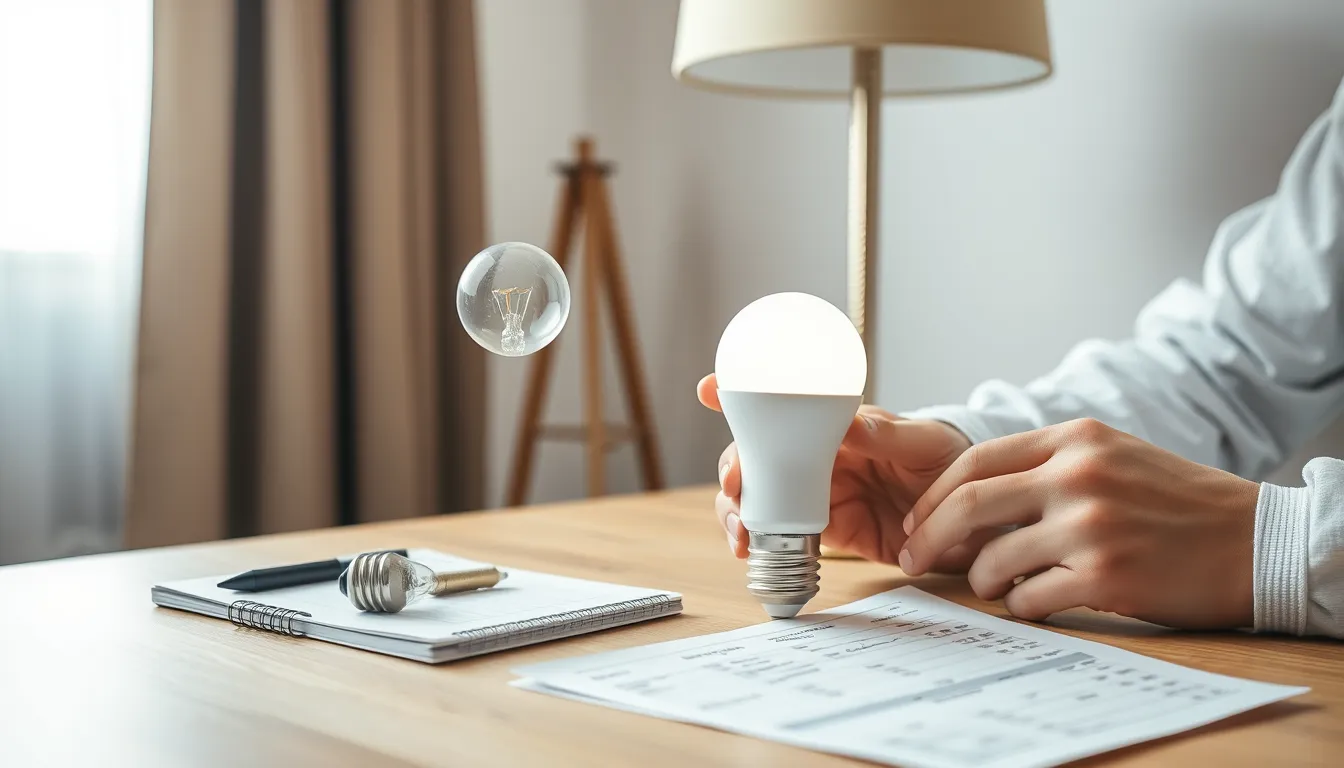
Lighting is one of the simplest renter-controlled upgrades. The U.S. Department of Energy states that LED bulbs use up to 80% less energy than incandescent bulbs and last much longer [2]. DOE’s renter page also notes that the average household can save more than $200 per year by using LED lighting, though actual savings depend on how many bulbs you use, how long they run, and your electricity rate [1]. That figure is an average for a household, not a promise for a particular apartment.
Check the fixture before buying: the bulb shape and base, whether the fixture is enclosed, and whether it is on a dimmer. Use lumens, not watts, to compare brightness; a bulb that is not dimmer-compatible may flicker or fail early. Keep a few original bulbs if your lease requires you to restore fixtures at move-out. Timers and dimmers can also reduce unnecessary lighting, and DOE lists them among renter-friendly DIY options [1].
Take charge of plug loads and standby power
Many devices use electricity even when they are not performing their main job. This is often called standby power or phantom load. Energy Saving Trust recommends switching appliances off at the plug and avoiding standby where practical [4]. A power strip can make that easier for a group of electronics, chargers, or a desk setup: switch the strip off when the group is not in use. Do not put a refrigerator, freezer, space heater, or other high-load appliance on a standard strip unless the strip and appliance are rated for that use. The goal is to control loads safely, not to create a tangle of extension cords.
This step is usually small per device, so treat it as a habit rather than a headline saving. It is most useful when several devices stay on around the clock. If you want to know whether it matters in your home, compare a week with the strip switched off against a similar week with it on, using the same billing period length and similar weather.
Run appliances and hot water more deliberately
Appliance habits can reduce energy without buying anything. Run dishwashers and washing machines with full loads when possible, choose lower-temperature wash settings when fabric care allows, air-dry dishes or clothes when practical, and keep dryer lint filters clean. These actions reduce unnecessary hot-water and motor use, but the savings depend on the appliance, your habits, and how often you run it. Energy Saving Trust includes using appliances more efficiently among the quick, low-cost steps available to renters [4].
Hot water is often a major household energy use, but renters should be careful about equipment changes. If you have access to a water heater and your lease permits adjustment, ask the landlord or property manager about the safe setting rather than changing a gas appliance yourself. Shorter showers, full laundry loads, and cold-water washing are renter-controlled ways to reduce hot-water demand without touching the equipment.
Reduce heating and cooling waste with controls and habits
Heating and cooling usually dominate home energy use, but renters often cannot replace the furnace, air conditioner, or ductwork. Start with what you can control: keep vents and returns clear of furniture, use window coverings to manage solar heat, and set the thermostat deliberately when home and away if the lease allows. Do not install a smart thermostat or change thermostat wiring without landlord approval; compatibility and lease terms vary. Energy Saving Trust identifies heating controls as a larger improvement renters can discuss with their landlord [4].
If a room is uncomfortable because of a draft, a broken window, or an HVAC problem, document it and ask for repair. That is a maintenance issue as well as an energy issue. Avoid using a space heater as a substitute for a working heating system without checking lease rules and electrical capacity; space heaters can be expensive to run and can create fire or overload risks.
Ask the landlord about larger improvements
Some changes are not renter DIY projects: insulation, heating controls, duct sealing, window replacement, and major air sealing generally require the property owner’s approval and often a qualified contractor. Energy Saving Trust suggests speaking with the landlord about insulation and heating controls when possible [4]. DOE’s renter page notes that many incentives are available to renters, though suitability depends on the type of rental property and program [1].
Make the request specific and in writing. Describe the problem, include photos or dates, and ask what the landlord is willing to approve. Focus on comfort, safety, maintenance, and documented energy waste rather than promising an exact payback. If the landlord agrees to a change, clarify who buys the equipment, who installs it, whether the lease allows it, and what happens at move-out.
Worked example: estimating a lighting change
Suppose, as an illustrative example, a renter replaces 10 incandescent bulbs rated at 60 watts with 9-watt LED bulbs. The bulbs run 3 hours per day for a 30-day month, and the illustrative electricity price is $0.16 per kWh. These are hypothetical inputs, not measured usage or a current price. The formula is:
energy_kWh = watts / 1000 × hours_per_day × days
variable_cost = energy_kWh × price_per_kWh
| Step | Value | Calculation |
|---|---|---|
| Old lighting energy | 54 kWh | (10 × 60 / 1000) × 3 × 30 |
| New lighting energy | 8.1 kWh | (10 × 9 / 1000) × 3 × 30 |
| Energy saved | 45.9 kWh | 54 − 8.1 |
| Illustrative bill saving | $7.34 | 45.9 × $0.16 |
The result is about $7.34 per month under those assumptions, before taxes, fixed charges, and any change in your rate. It does not include the cost of the bulbs, and it assumes the LEDs deliver the same light and run the same hours. If your bulbs are already LEDs, or if the fixture is rarely used, the saving will be smaller. Use your own wattage, hours, rate, and billing days to replace the illustrative numbers.
Renter action checklist
- Read the lease for rules on adhesives, window film, thermostat changes, and alterations.
- Collect two comparable bills and note billing days, usage, fixed charges, and taxes.
- List drafty windows and doors, bulb types, chargers, and appliances that run with partial loads.
- Install removable weatherstripping, draft stoppers, or window film where safe and permitted.
- Replace compatible bulbs with LEDs and keep original bulbs if restoration is required.
- Use power strips for electronics and chargers, not for high-load appliances unless rated.
- Run full loads, use cold water when possible, and air-dry when practical.
- Document maintenance problems and ask the landlord in writing about insulation, heating controls, and repairs.
- After a change, compare equivalent billing periods rather than a single bill.
Common mistakes to avoid
Permanent caulk or adhesive can damage a rental and may violate the lease; use removable products or get written permission. Blocking vents or sealing around combustion appliances can create safety and performance problems. Buying a bulb that is not compatible with a dimmer or enclosed fixture can cause flicker, overheating, or early failure. Assuming a device uses no power because it is switched off ignores standby load. Finally, treating an average savings figure as a guarantee can lead to disappointment: your bill also reflects weather, rates, fees, occupancy, and the building itself.
The most useful next step is to gather your last two comparable bills and make a short room-by-room list of drafts, bulbs, and always-on devices. Make one renter-safe change, then compare a similar billing period. If the change involves the building, the heating system, or the lease, put the request to the landlord in writing and keep the response.
FAQ
Can I use caulk to seal drafts in a rental?
Permanent caulk may damage surfaces or violate a lease. Renter-safe alternatives include peel-and-stick weatherstripping, door draft stoppers, and removable window insulation film; get written permission before using anything permanent.
Will switching to LEDs guarantee lower bills?
No. LEDs reduce lighting energy per hour, but bill savings depend on how many bulbs you use, operating hours, your electricity rate, and whether the old bulbs were already efficient. DOE's average savings figure is not a guarantee for every apartment.
Should I install a smart thermostat in a rental?
Ask the landlord first. Wiring, HVAC compatibility, and lease terms vary, and savings depend on your schedule, climate, system, and utility rate rather than on the device alone.
What larger upgrades should I ask the landlord about?
Insulation, heating controls, major air sealing, and HVAC repairs are reasonable topics. Document comfort or draft problems, ask in writing, and note that incentive eligibility depends on the property and program.
Follow the evidence
Sources & references
- U.S. Department of Energy. Renters. https://www.energy.gov/save/renters (no publication date shown).
- U.S. Department of Energy. 5 Tips for Energy-Saving Renters. July 19, 2023. https://www.energy.gov/articles/5-tips-energy-saving-renters
- Energy Trust of Oregon. No-cost and low-cost efficiency tips for renters. Updated October 12, 2026. https://www.energytrust.org/residential/tips/no-cost-and-low-cost-efficiency-tips-for-renters/
- Energy Saving Trust. How to save energy if you're renting (according to our experts). 6 October 2026. https://energysavingtrust.org.uk/how-to-save-energy-and-money-if-you-rent-your-home/
Useful terms in this guide
- Weatherstripping
- A flexible strip or seal that closes gaps around windows and doors; removable types are suitable for rentals.
- Standby power
- Electricity used by devices when they are off or not performing their main function, often called phantom load.
- LED
- Light-emitting diode bulb; it converts more electricity to light and less to heat than an incandescent bulb.
- Air sealing
- Closing unintended gaps in a building envelope to reduce drafts; renter-safe methods are removable.
Have a question about these numbers?
Tell us what needs a closer look.